AI Contents Inventory Software for Public Adjusters
Turn damaged-item evidence into priced, sourced, depreciated contents line items — without spending days researching every item by hand.
What does AI contents inventory software actually do for a public adjuster?
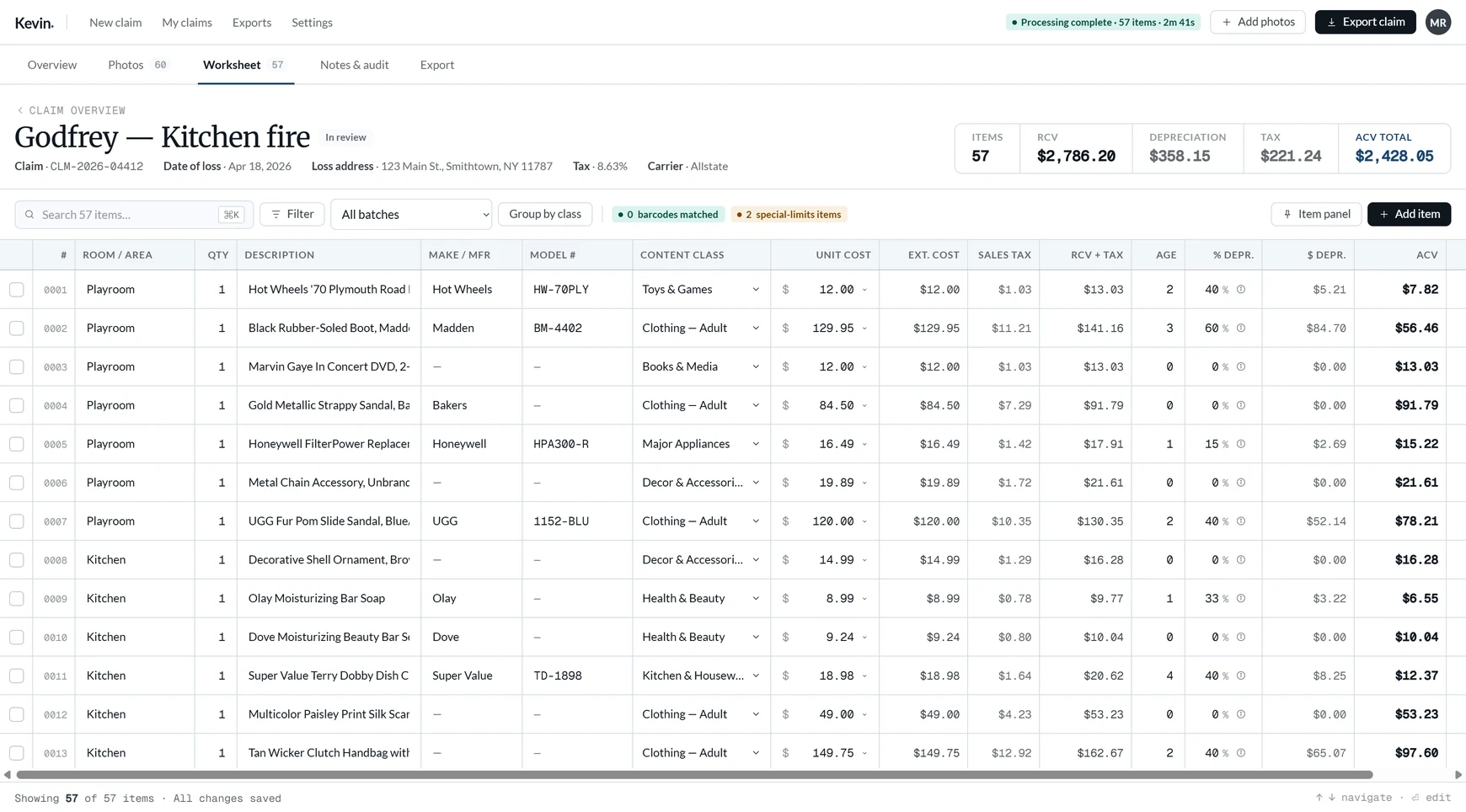
It takes the photographs you already shoot on site and returns priced, classified, depreciated line items with a source link on each one — leaving you the judgment calls instead of the typing.
The work it removes is the repetitive part: describing each item, finding what it costs to replace today, copying the listing URL, choosing a content class, and applying the right depreciation for the item's age. The work it does not remove is yours — grouping ambiguous evidence, pricing collectibles, and deciding what a line is worth on this claim. Nothing reaches a carrier until you have reviewed it.
Contents claims should not take weeks to build
A single pack-out can run to hundreds of photographs. Built by hand, each one becomes a search, a comparison across several retailers, a copied link, a guess at a category and a depreciation lookup — then a row typed into a spreadsheet that the carrier's system will reject if a cell holds a formula instead of a number. Multiply that by four hundred items and the bottleneck is not judgment. It is transcription.
What Kevin automates
Item identification
Read from the photographs, with several independent signals weighed together — no single one is trusted on its own, and a frame that cannot be read is flagged rather than guessed.
Multi-photo grouping
A wide shot and a model-plate close-up taken seconds apart become one line, priced once. You merge, split or exclude the proposed sets first.
Replacement-cost research
The Kevin Content Pricing Engine searches current listings across retailers, specialty stores, brand-direct storefronts and marketplaces in one query per item.
Source substantiation
The listing behind each price is stored on the line — retailer, title and direct URL — and prints into the export.
XactContents classification
Each line carries a content class, which is what drives its depreciation schedule and what the XactContents template expects.
Depreciation, RCV and ACV
Age and class against 31 categories and 87 sub-lines. The server computes it; the page only renders the answer, so the worksheet and the export never disagree.
How it works, start to export
These are the product's own stages, in the order you meet them. Quota is charged at promotion — the moment a reviewed set becomes a claim item — not when photos land.
- 01Photos inDrop a folder, a phone dump or a whole .zip. Nothing is a claim line yet, and nothing is charged.
- 02ReviewedShots of one item are proposed as one item. You confirm, merge or split before anything is priced — and a line counts against your allowance once it becomes a line, not when the photo lands.
- 03PricedEach line gets a price from a listing with the source kept on the row, a content class, and depreciation for its age.
- 04ExportedXactimate (Excel) · .xlsx in the XactContents template, or a room-by-room PDF.
Built for claims accuracy, not object counting
That is also why the line count on a claim is at or below the photo count. Software that reports more items than photographs is counting objects in a scene, which is a different job from building an insurance line item.
What comes out
| Output | Format | What it is for |
|---|---|---|
| Carrier worksheet | Xactimate (Excel) · .xlsx | The XactContents template, with static values in every derived cell because the importer rejects formulas. |
| Inventory PDF | Room by room with photographs, for the file and for the insured. | |
| Source links | On every priced line | The listing the price came from, kept on the row and printed in the export. |
Kevin exports a file you send. It does not push into carrier systems, and it has no carrier-facing review surface.
Common questions
Can Kevin get make and model from a photograph?
What happens when I have several photos of the same item?
How is depreciation applied?
Does Kevin export something XactContents can import?
Can Kevin price items when the photos are gone?
Is this built for professionals or homeowners?
Build contents claims faster with Kevin.
Your first 250 line items are free, with no clock running. $249/mo after that, unlimited claims.
Related
- How Kevin works, screen by screenIntake, staging, processing, the worksheet and the export, with real screenshots.
- Pricing: $249/mo, unlimited claims2,000 line items a month included, then $0.20 an item. First 250 free.
- A finished claim you can openReal priced lines with depreciation, totals and the source link on each row.
- Kevin for independent and public adjustersWhat the workflow looks like on a real contents loss.